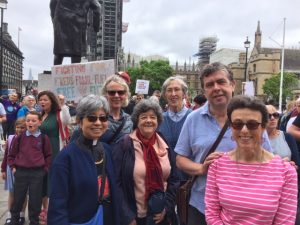
People from Living Spirituality Connections and St James’s Church Piccadilly at Parliament Square
Living Spirituality Connections
Resources for deeper living
This blog post has been written by Petra Griffiths, Coordinator of Living Spirituality Connections.
Time to take action on climate crisis and biodiversity loss
Following the challenging and motivating workshop we held on 8 June on Human Flourishing on a Flourishing Earth, here is a link to The Time is Now. Mass Lobby for our Climate, Nature and People on 26 June: https://www.theclimatecoalition.org/thetimeisnow;
and to the free Christian Aid training day on 25 June for the lobby on 26 June: https://www.eventbrite.co.uk/e/keep-moving-campaign-workshop-register-interest-tickets-61488557932?aff=ebdssbdestsearch?_$ja=tsid:57200|cgn:20190609-CA-CAM-ML5-Signed|kw:txt-body-Workshop&utm_source=christianaid&utm_medium=email&utm_content=txt-body-Workshop&utm_campaign=20190609-CA-CAM-ML5-Signed
Nicola Peel, the keynote speaker at the workshop, described by many as inspiring and outstanding, has suggestions for What one person can do about these crises on her website: http://eyesofgaia.com/pb/wp_42073ad1/wp_42073ad1.html
This is a blog post by Heather-Jane Ozanne the co-ordinator of our Towards Human Flourishing Special Interest Group and a member of the LSC Working and Discernment Group.
Much has been written about the power of hope and opinion seems to be divided on its’ usefulness and value. Some see hope as something negative – leading to apathy and inertia. Others point to ‘false hope’ attributing to it the means of making life bearable, other see in it quite the opposite, the devastating effect when a false hope is revealed as precisely that – false.
More often I believe hope is seen as something positive, it can keep us going and strengthen resolve when times are tough or uncertainty abounds. It can be a motivating and revivifying force.
Episcopal Priest and author, Cynthia Bourgeault points out the optimism that can ensue from hope, ‘In our usual way of looking at things, hope is tied to outcome. We would normally think of it as an optimistic feeling – or at least a willingness to go on – because we sense that things will get better in the future’.
However, hope like love is a quality that is multifaceted and not always easy to put into words. I would like to consider here a few aspects of hope that I find particularly helpful and are perhaps not so commonly recognised. One aspect described in the following quotation:
Hope is definitely not the same thing as optimism. It is not the conviction that something will turn out well, but the certainty that something makes sense, regardless of how it turns out. -Václav Havel, Disturbing the Peace (1986)
Here we see hope as something which is not connected to outcome but to something which seems right at an inner level. It brings with it a sense that we must be a certain way, or do a certain thing because it has intrinsic value in itself – regardless of the outcome. It is a quality of being, even a way of life, going beyond positive thinking into positive living.
Today I hear many people expressing a sense of hopelessness about the many huge challenges facing our world, from climate challenges and loss of biodiversity to polarisation and growing inequality.
Havel provides a counter to this despair:
Even a purely moral act that has no hope of any immediate and visible political effect can gradually and indirectly, over time, gain in political significance.
This is a crucial factor in what I think of as “participatory hope”. This kind of hope is a quality of the heart. The deep heart which sees all things , connects all things, holds all things together in compassionate love. Hope can be both a call and the fuel for action.
In the words of peace activist, Fr John Dear, ‘to be hopeful, do hopeful things’.
There is a growing emphasis on the daily practice of expressing gratitude and how it can lead to a more fulfilled life, from religious teachings to the evidence- based insights from the field of Positive Psychology.
Here, I would like to suggest a practice of regularly reflecting on what hopeful actions one can take no matter what the situation and then going out and doing them!
Saturday 19 May 2018, 10.15am – 5.15pm

In the face of growing complexity and diversity in our local and global communities, and our increasingly unsustainable way of life, we need a new form of intelligence, and related skills and tools, to enable us to be effective agents for change. We will explore how working with emergent processes can help us become more effective in working for a world where all can flourish. We will also look at the skills we need to develop to work with emergence.
Chris Mowles – Professor of Complexity and Management, University of Hertfordshire – Working with Emergence.
Rev. Dr Terry Biddington – Dean of Spiritual life and lecturer in Practical and Eco Theology, University of Winchester – The Emergence of Interiority and the Development of Religion in an Evolving Universe.
Venue: King Alfred Campus, University of Winchester
Booking: Advance booking essential. Cost: £25, payable on booking. To book go to: http://store.winchester.ac.uk/conferences-and-events/institute-for-theological-partnerships/events/working-with-emergence.
This interactive event will begin with a keynote address by Chris Mowles. He will address key questions encountered when working with Complexity and Emergence, with particular reference to how this learning can be thought about in group settings.
Following the lecture Professor Chris Mowles will lead us in a large group process, drawing from his training with the Institute of Group Analysis.
In the afternoon Rev Dr Terry Biddington will give a keynote address exploring the emergence of interiority as part of the process of cosmic evolution, to show how religion is something that is unfinished and evolving, much as the universe is.
Small group discussion: Following this talk there will be small facilitated groups exploring themes of the day and how they can be applied practically. The day will end with feedback from the groups.
Tea and coffee will be provided in the morning and afternoon. Please bring your own lunch. Hot drinks are available nearby at lunchtime.
Although this day is a stand-alone event, it forms part of a wider programme at the Institute for Theological Partnerships, based on spiritually inspired training offered by Spirit
of Peace.
For any further questions, please email petragriffiths@livingspirit.org.uk.
The University of Winchester King Alfred Campus (the exact location will be emailed to those booking). Winchester is easily accessible by train from Gatwick Airport and around an hour
from central London. Winchester is a major tourist destination in the south-east of England. Consider staying longer to see more of the city if you are able to.
The Campus is about a 15 minute walk from the station. A taxi costs around £6. If anyone would like to share a taxi from the station or do the walk with the help of someone who knows the shortest route, we will do our best to co-ordinate this. Please contact petragriffiths@livingspirit.org.uk for more details.
The event leaflet can be downloaded from www.livingspirit.org.uk/wp-content/uploads/working_with_emergence.pdf.
The event poster can be downloaded from www.livingspirit.org.uk/wp-content/uploads/emergence_poster.pdf.
A short article on Working with Emergence can be downloaded from www.livingspirit.org.uk/wp-content/uploads/emergence_article.pdf.
The event is organised by the Institute for Theological Partnerships at the University of Winchester in association with Spirit of Peace and Living Spirituality Connections.
On Sunday LSC will be at the Eco Fun Palace Day at St James’s Piccadilly with an art stall and a labyrinth walk. The strapline for Fun Palaces is “Everyone an artist, everyone a scientist.” and all the activities are participatory. Fun Palaces are being created all over the UK on 7 and 8 October: http://funpalaces.co.uk/ For news of the St James’s Eco Fun Palace go to: http://www.sjp.org.uk/…/eco-church-7-october-2017-at-st-jam…
I hope to get a chance to dip your toe in at one of these events.
Petra Griffiths
Fun Palaces – Everyone an Artist, Everyone a Scientist
Fun Palaces – Everyone an Artist, Everyone a Scientist
funpalaces.co.uk
Our autumn newsletter is now available, exploring the area of human flourishing, the way of the heart, responding to recent violent episodes in the UK from a spiritual perspective, and looking at what constitutes really effective listening. We also look at music and spirit, and a life that radiates gratitude and joy despite hard beginnings.
You will find the newsletter here: www.livingspirit.org.uk/wp-content/uploads/2017-autumn-newsletter.pdf
Petra Griffiths
Events all over the UK are publicised in this listing which you can find at:
https://home-5016243824.webspace-host.com/wordpress/wp-content/uploads/events_oct-dec17.pdf
In the Radio 4 Programme Something Understood broadcast on Christmas Day 2016 on the topic of goodwill, Professor June Boyce-Tillman (our Music and Spirituality coordinator) gives an excellent summary of some of the key ideas that inspire Living Spirituality Connections:
You can listen to the interview below.
We’ve published our April to June events listing with details of events all over the country.
You can download it here – www.livingspirit.org.uk/wp-content/uploads/events_april-june17.pdf.
This is a blog post by Heather-Jane Ozanne, the co-ordinator of our Towards Human Flourishing special interest group and a member of the LSC Working and Discernment Group.
I am writing during the paradoxical season of Lent – paradoxical because, even as it is often a time of abstinence, absence and darkness, it is also a time when the earth wakes from its winter hibernation and new life and flourishing emerge as the lengthening days and gathering light moves us steadily towards Easter. It is a good time to reflect on the meaning of Human Flourishing – and that’s just what we plan to do in LSC.
Questions such: as what does it mean to flourish as a human being; what insights do our religious traditions and academic disciplines offer us; and can we develop an agreed ethic and socio/political strategies based on human flourishing for all? More personal questions such: as how am I and those around me flourishing/not flourishing; and what am I prepared to do to promote and develop communities where all have the opportunity to flourish? These are big questions, questions that as Rilke suggests, we may have to live in conversation with and find we live into the answers.
There have been some recent interesting developments in LSC and partner organisations. [Read more…] about Towards human flourishing
